


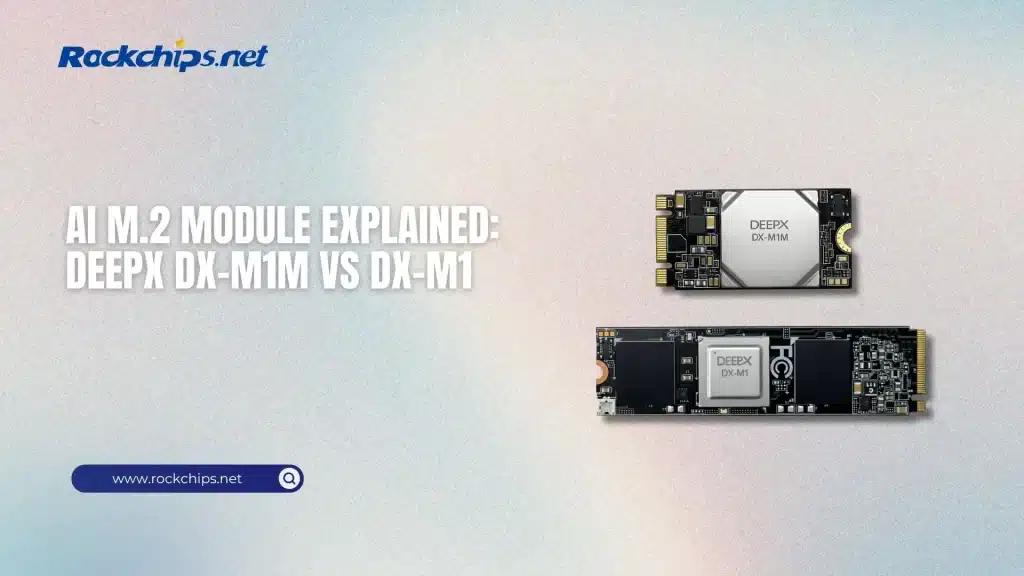
A practical way to bring AI to the edge is through the AI M.2 Module – a compact, scalable, and energy-efficient solution for real-time inference. In this article, we discuss what an AI M.2 module is, why it’s important, and how DEEPX DX-M1M and DEEPX DX-M1 are leading the way in the next wave of edge AI computing.
What Is an AI M.2 Module?
An AI M.2 Module is a compact hardware accelerator that fits into a standard M.2 slot (commonly used for SSDs or wireless cards). Instead of storage or connectivity, these modules provide dedicated AI processing power.
Unlike traditional CPU or GPU systems, AI M.2 modules are specifically optimized for neural network inference, resulting in lower power consumption, increased efficiency per watt, real-time AI processing at the edge, and minimal latency without relying on cloud services. These modules are commonly employed in smart surveillance, robotics and automation, industrial AI inspection, smart retail and people counting, as well as edge AI gateways.
Why AI M.2 Modules Are Gaining Popularity
The rise of edge computing has created a strong demand for efficient AI hardware. The AI M.2 Module format solves several critical challenges:
- Compact Integration: M.2 modules allow AI acceleration to be added without redesigning entire systems. Especially useful for SBCs, mini PCs, and embedded boards.
- Power Efficiency: Traditional GPU-based AI systems can consume tens or hundreds of watts. AI M.2 modules often operate in the 1–5W range, making them ideal for embedded deployments.
- Scalability: Multiple modules can be used in parallel, enabling scalable AI workloads without major architectural changes.
- Cost Optimization: Edge AI deployments become much more affordable than cloud-based inference or high-end GPU solutions.
DEEPX DX-M1M and DEEPX DX-M1 Overview
DEEPX has introduced a new class of AI accelerators designed specifically for edge intelligence. The DX-M1M and DX-M1 modules bring high-performance AI capabilities into extremely power-efficient form factors.
DEEPX DX-M1M
The DEEPX DX-M1M is an ultra-compact AI M.2 module designed for embedded applications with limited space and power. It features an M.2 form factor for easy integration and is optimized for edge AI inference, offering ultra-low power consumption of approximately 1–5W and high AI throughput of up to around 200 TOPS. Supports multiple AI models running simultaneously, making it ideal for cameras, IoT devices, and robotics. This module is particularly suitable for applications where size and efficiency are critical, such as smart sensors or compact edge devices.
DEEPX DX-M1
The DEEPX DX-M1 builds on the same architecture but targets more demanding AI workloads. It offers higher scalability and a broader performance envelope, along with an advanced memory architecture optimized for multi-model execution. Despite these enhancements, it maintains ultra-efficient power consumption in the 2–5W range. Designed for industrial AI, smart cities, and advanced robotics, the DX-M1 enables real-time decision-making at the edge. Positioned as a next-generation edge AI processor, it is capable of replacing larger, more power-hungry systems.
Comparison Table: DEEPX DX-M1M vs DX-M1
How AI M.2 Modules Compare to GPUs and NPUs
When evaluating an AI M.2 Module, it’s important to understand how it differs from other AI hardware. Compared to GPUs, which offer high performance but consume significant power (50–300W), AI M.2 Modules provide a lower performance ceiling but are vastly more efficient per watt. Unlike CPUs, which are general-purpose and inefficient for AI, AI Modules are purpose-built for neural networks.
While NPUs integrated in SoCs have limited scalability, AI M.2 Modules are expandable and upgradeable. This makes AI M.2 modules ideal for edge-first architectures, where prioritizing efficiency and scalability surpasses the need for raw peak performance.
Practical Examples of Application
The flexibility of an AI M.2 Module allows it to be used across various industries, including:
- Smart surveillance — real-time object detection, face recognition, anomaly detection without cloud latency.
- Industrial automation — defect detection, predictive maintenance, and quality inspection on production lines.
- Robotics — autonomous navigation, obstacle detection, and AI-based decision-making.
- Smart retail — customer analytics, people counting, and behavior tracking.
- AIoT devices — voice assistants, smart home hubs, and edge AI gateways.
Advantages of DEEPX AI M.2 Modules
DEEPX solutions stand out due to several architectural advantages:
- Extreme efficiency: delivering high AI throughput at just a few watts.
- Parallel AI execution: multiple models can run simultaneously.
- Edge-first design: eliminates dependency on cloud infrastructure.
- Scalable deployment: from single devices to large distributed systems.
These features position DEEPX modules as a strong alternative to traditional AI hardware.
Challenges and Considerations
While AI M.2 modules offer many benefits, there are still some considerations:
- Software ecosystem maturity (SDKs, frameworks).
- Compatibility with host systems (PCIe lanes, BIOS support).
- Thermal design in compact environments.
- Optimization of AI models for specific hardware.
Careful system design is required to leverage their capabilities fully.
Future of AI M.2 Modules
The AI M.2 Module category is poised for rapid growth as edge AI adoption increases. Anticipated advancements include higher TOPS-per-watt ratios, improved AI software stacks, better integration with SBCs and embedded platforms, and broader industry standardization. As AI advances toward the edge, these modules will become fundamental components of intelligent systems.
Conclusion
The AI M.2 Module is emerging as one of the most practical and efficient ways to deploy artificial intelligence at the edge. It combines compact design, low power consumption, and scalable performance in a format that integrates easily into modern hardware systems.
Solutions like DEEPX DX-M1M and DEEPX DX-M1 demonstrate how far edge AI acceleration has evolved. With performance reaching hundreds of TOPS at just a few watts, they redefine what is possible outside the data center.
For developers, system integrators, and businesses creating next-generation AI devices, AI M.2 modules are not just an option; they are rapidly becoming the standard now.
FAQ
An AI M.2 module is used to accelerate AI inference directly on edge devices such as cameras, robots, and industrial systems.
It is installed into a standard M.2 slot (typically PCIe-based), similar to an SSD.
They are not necessarily more powerful than GPUs, but they are far more efficient for edge AI workloads.
Its combination of ultra-low power consumption and high AI throughput in a compact M.2 form factor makes it ideal for embedded systems.
Yes, both DX-M1M and DX-M1 support multi-model execution thanks to their advanced memory architecture.
