


Introduction
People‑tracking technology has evolved from simple infrared door counters to sophisticated AI‑powered systems capable of real‑time occupancy analytics, flow mapping, queue detection, and behavioral insights.
Today, organizations use people tracking systems in:
- Retail stores (footfall and dwell time)
- Smart offices (occupancy optimization)
- Transportation hubs (crowd flow management)
- Industrial facilities (worker safety monitoring)
- Public venues (capacity compliance)
However, not all people tracking technologies are the same. The choice of sensor and processing architecture directly affects accuracy, privacy, scalability, and cost.
This guide provides a technical overview of modern people tracking technology and explains how edge AI platforms – including Rockchip‑based solutions – fit into practical deployments.
Learn more:
Rockchip RK817-1 PMIC: Architecture and Linux Integration
Desk Occupancy Sensor: Technologies & Selection
RK3688 vs RK3668: Rockchip’s Next‑Generation Chips
Table of Contents
What Is People Tracking Technology?
People tracking technology refers to systems that detect, monitor, and analyze human presence and movement within a defined space.
Depending on the implementation, systems may provide:
- People counting (entries/exits)
- Real‑time occupancy
- Zone‑based analytics
- Heatmaps and flow patterns
- Queue detection
- Anonymous trajectory tracking
A key engineering decision is whether to use individual‑level tracking or simply aggregate occupancy metrics. In many commercial use cases, anonymous counting is sufficient and reduces privacy complexity.
Core Architecture of a People Tracking System
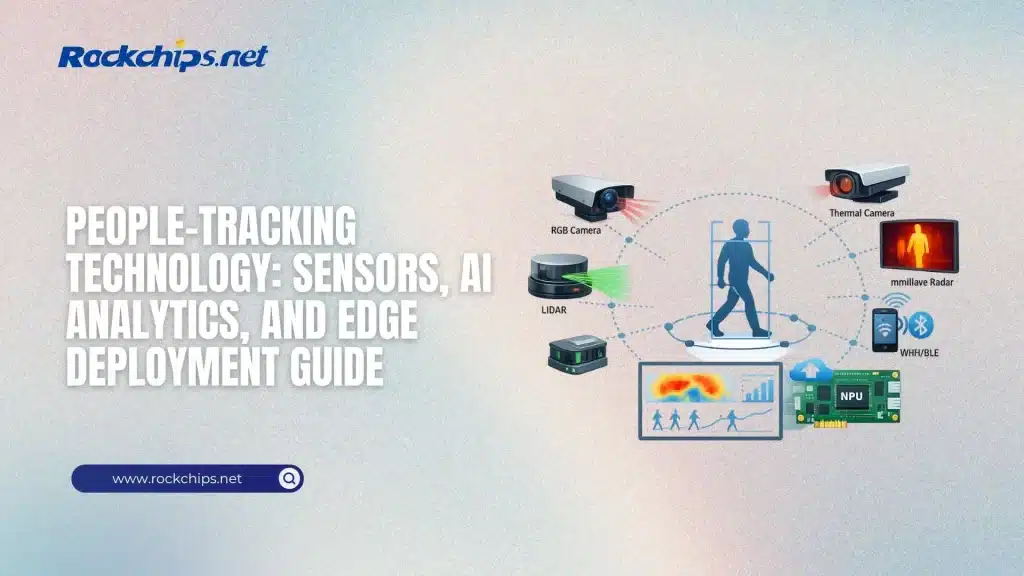
Most deployments follow an integrated technical pipeline: starting with sensors such as cameras, LiDAR, radar, thermal, or RF‑based devices that gather environmental data. AI and signal‑processing algorithms in the detection layer identify human presence, while the tracking layer assigns temporary IDs to maintain continuity across multiple objects. The analytics layer aggregates this data into key performance indicators like foot traffic, dwell time, and queue length. Data is then delivered through APIs, dashboards, building management systems (BMS), or business intelligence tools in the integration layer. Finally, the governance layer enforces privacy measures, data retention policies, and system security.
Comparison of Major People Tracking Technologies
Vision‑Based People Tracking
Camera‑based people tracking technology remains the most adaptable method, leveraging modern AI models that perform person detection with convolutional neural networks, multi‑object tracking, zone logic, and event detection. This approach offers rich analytics such as queues, dwell times, and pathways, exhibiting strong performance when properly calibrated. However, it is sensitive to occlusion, reliant on lighting conditions, and requires higher privacy compliance.
LiDAR and Radar‑Based Tracking
LiDAR
LiDAR detects people as geometric point clusters rather than images.
Advantages:
- Works in darkness
- Privacy‑friendly
- Reliable doorway counting
Challenges:
- Higher hardware cost
- Installation precision required
mmWave Radar
Radar systems detect motion and micro‑movements through RF reflections.
Advantages:
- Strong privacy profile
- Robust in low‑light conditions
- Good for occupancy monitoring
Challenges:
- Multipath reflections in complex environments
- Typically less rich than vision analytics
Thermal‑Based Tracking
Thermal imaging detects heat signatures rather than visible features.
Benefits:
- Works in total darkness
- Reduced identity exposure
Constraints:
- Environmental heat interference
- Limited fine‑grained behavior analytics
Edge AI in People Tracking Technology
One of the most important shifts in recent years is moving AI inference from the cloud to the edge.
Why Edge Processing Matters?
- Lower latency
- Reduced bandwidth costs
- Improved privacy
- Higher system resilience
Instead of streaming raw video to the cloud, modern systems:
- Perform detection locally
- Generate metadata (counts, dwell, tracks)
- Transmit only structured data upstream
Rockchip‑Based Edge AI Solutions
Rockchip SoCs are widely used in embedded AI systems due to their integration of:
- Multi‑core ARM CPU
- Hardware video encoder/decoder
- Dedicated NPU (Neural Processing Unit)
A typical Rockchip‑based people tracking deployment includes:
- Camera input decoded via hardware accelerator
- Person detection model executed on the NPU
- Multi‑object tracking handled by CPU/GPU
- Metadata exported via MQTT/HTTP
Using an NPU reduces CPU load and power consumption, making Rockchip platforms suitable for:
- Smart retail devices
- AI‑enabled kiosks
- Embedded occupancy sensors
- Industrial edge gateways
Edge AI architecture improves compliance by keeping raw imagery local and exporting only analytics data.
Accuracy Factors in Real Deployments
People‑tracking accuracy depends more on engineering decisions than on sensor choice alone.
Key variables include:
- Mounting height and angle
- Field‑of‑view coverage
- Crowd density
- Occlusion management
- Calibration and zone definition
- Validation against manual ground truth
Pilot testing before full deployment is strongly recommended.
Privacy and Regulatory Considerations
Privacy is central to any people tracking deployment.
Best practices include:
- Prefer anonymous counting when possible
- Avoid long‑term raw video storage
- Use edge inference
- Apply strict data retention limits
- Provide transparent user notices where required
For highly sensitive areas (restrooms, medical spaces), radar‑ or LiDAR‑based approaches are generally preferred over RGB analytics.
Future Trends in People Tracking Technology
Emerging developments include:
- Multi‑sensor fusion (camera + radar)
- Federated learning at the edge
- Improved transformer‑based tracking models
- Real‑time crowd density modeling
- AI‑based anomaly detection
As hardware accelerators improve, more analytics will move fully to embedded devices.
Conclusion
People tracking technology encompasses a wide range of sensing methods and AI‑driven analytics systems. Vision‑based systems offer the richest behavioral insights, while LiDAR, radar, and thermal approaches provide stronger privacy characteristics and robustness in low‑light environments.
Edge AI has become the preferred deployment architecture, enabling real‑time analytics with reduced bandwidth and improved privacy control. Platforms integrating AI acceleration – such as Rockchip NPU‑based systems – make it practical to deploy intelligent people‑tracking solutions at scale across retail, smart buildings, transportation, and industrial environments.
The optimal solution depends on use case requirements, privacy expectations, installation constraints, and long‑term scalability goals.
FAQ
It is used to measure occupancy, analyze crowd flow, optimize space utilization, improve safety, and enhance operational efficiency.
No. People tracking can operate anonymously without identifying individuals. Facial recognition is a separate biometric technology.
LiDAR, mmWave radar, and IR‑based counters generally offer stronger privacy characteristics than RGB video systems.
Yes. Edge AI devices can process data locally and export only aggregated analytics without continuous cloud connectivity.
With proper calibration, camera‑based AI systems can achieve high accuracy, but performance depends on the environment, density, and installation quality.
Sources
- Rockchip RKNN Toolkit Documentation
- Ultralytics RKNN Integration Guide
- ByteTrack Multi‑Object Tracking Paper (arXiv:2110.06864)
- mmWave People Counting Research Overview – ScienceDirect
