


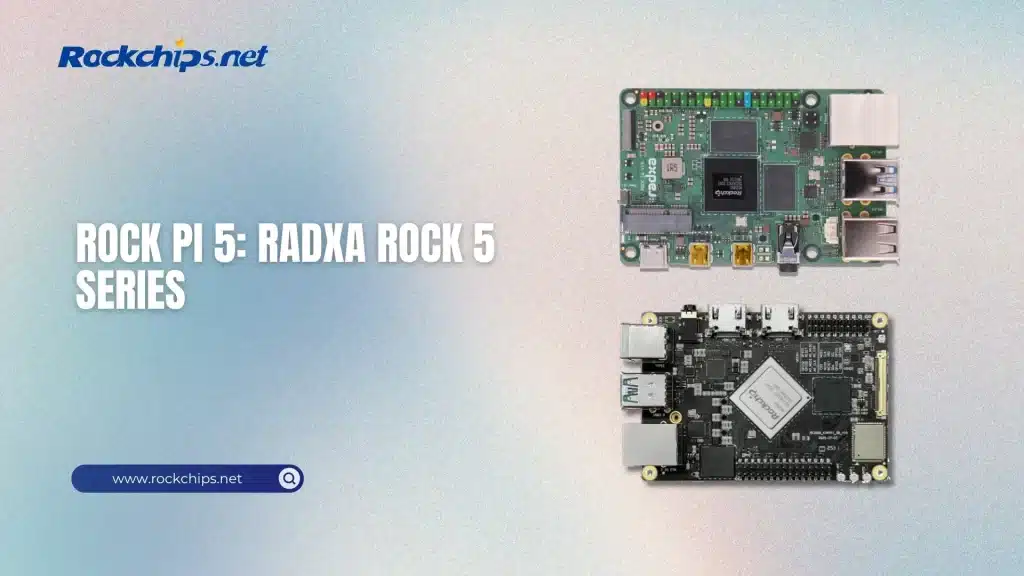
Rock Pi 5 refers to a modern Radxa ROCK board in the 5-series, even though Radxa’s branding has traditionally included both ROCK Pi (older models) and ROCK 5 (newer RK3588/RK3588S-based models). In practice, the Rock Pi 5 discussion usually focuses on boards like Radxa ROCK 5A (RK3588S) and Radxa ROCK 5B / 5B+ (RK3588 / RK3588 with more extensive I/O).
This article explains what people typically mean when mentioning Rock Pi 5, highlights the strengths of these boards, and compares them to Kiwi Pi 5 and Raspberry Pi 5.
Rock Pi 5 Usually Refers To
1) Radxa’s RK3588S/RK3588 generation
The most common intent behind Rock Pi 5 is: a Radxa board in the “5” performance tier – typically:
- Radxa ROCK 5A: compact RK3588S SBC, positioned as a high-performance maker/embedded board.
- Radxa ROCK 5B: RK3588 SBC with broader expansion and higher-end I/O options.
- Radxa ROCK 5B+: a refreshed variant adding upgrades like onboard Wi-Fi 6 / BT 5.2 and additional interfaces (varies by revision).
2) Why does the naming confusion persist?
Radxa also operates the rockpi.org brand umbrella used for earlier ROCK Pi families; meanwhile, newer flagship boards are marketed under ROCK 5 naming. That’s why Rock pi 5″ is a very common shorthand online, even when the product page says ROCK 5A/5B.
Key Hardware Overview
CPU/GPU/NPU:
Rockchip’s RK3588 family (RK3588 or RK3588S):
- Big.LITTLE-style CPU setup with Cortex-A76 + Cortex-A55 cores (counts depend on board/SoC variant marketing), designed for strong burst performance and reasonable efficiency.
- GPU class typically in the Mali-G610 family on many RK3588 boards, aimed at modern graphics APIs and compute workloads (board/SoC dependent).
- Many RK3588 designs emphasize AI acceleration (often discussed as TOPS capability via an NPU on RK3588-class chips), which matters for camera pipelines, detection/classification, and edge inference.
I/O philosophy: expansion-first vs ecosystem-first
Radxa’s 5-series boards tend to attract users who care about expansion (storage, PCIe, camera/display lanes, networking). In contrast, Raspberry Pi boards tend to emphasize a stable mass-market ecosystem and documentation-to-availability pipeline.
Comparison Table: Rock Pi 5 (Radxa Rock 5A/B) vs Kiwi Pi 5 vs Raspberry Pi 5
Note: Rock Pi 5 here is represented by a typical Radxa ROCK 5A/5B class RK3588(S) board family, since that’s what the query usually targets.
Which One Should You Choose?
If your priority is pushing an SBC toward mini PC behavior (NVMe storage, high throughput peripherals, multiple high-bandwidth buses), the RK3588-class Radxa boards tend to be selected for that reason. Community benchmarking and reviews often focus on storage throughput and PCIe expansion as a core differentiator versus mainstream hobby boards.
Typical projects:
- Edge AI inference and camera pipelines
- Local dev boxes (containers, CI agents, lightweight builds)
- Media + multi-display experiments
- Prototyping embedded gateways that need faster storage
Choose Kiwi Pi 5 if you want an RK3588S-class board offered as a productized configuration.
Kiwi Pi 5 is positioned as an RK3588S-based SBC with defined RAM/eMMC configurations, which can be attractive.
Typical projects:
- Consistent deployments where eMMC matters
- AI/media workloads that benefit from RK3588S-class compute
- Product prototyping where BOM control is important
What about Raspberry?
Raspberry Pi 5 is a flexible option. It is often recommended for people who want a large ecosystem and compatible accessories, with an easy way to get started on basic maker and educational projects. Official documents highlight features like the PCIe interface (with an adapter or HAT), USB 3.0, support for two 4K displays, and the standard 40-pin header.
Typical projects:
- Education and broad maker community projects
- Accessories-driven builds (HATs, cases, cameras)
- Lightweight desktop usage and common SBC software stacks
Software and Support Considerations, Often More Important Than Specs.
Even when two boards look close on paper, day-to-day success depends on:
- Kernel and distro maturity for your exact board revision
- GPU/video pipeline support for your workload (desktop acceleration vs headless compute vs video decode/encode)
- Boot/storage workflows (microSD vs eMMC vs NVMe boot paths)
- Community volume (how quickly issues get reproduced and fixed)
As a rule: Raspberry Pi tends to win on “it just works” community reach; RK3588-class boards often win on “I can build a more expandable, higher-throughput system” when you’re willing to tune software.
Conclusion
Rock Pi 5 is commonly used as shorthand for Radxa’s ROCK 5 generation boards (like ROCK 5A/5B) built around the RK3588 family, which target high I/O flexibility and strong compute density.
Kiwi Pi 5 sits in the same performance neighborhood (RK3588S class) with productized configuration options.
Raspberry Pi 5 remains the ecosystem-centric choice, pairing solid CPU performance with strong official documentation and broad accessory support, plus a PCIe interface for expansion via adapters/HATs. Also, there is a new 16GB Raspberry Pi 5 for people who use it as an everyday PC.
If you’re choosing between them, decide based on your real bottleneck: software ecosystem and repeatability (often Raspberry Pi 5), or expansion/storage/throughput and edge compute density (often Rock Pi 5 class RK3588 boards).
Frequently Asked Questions (FAQ)
What is the Radxa ROCK 5 (Rock Pi 5) series?
The Radxa ROCK 5 series is a family of high-performance single-board computers developed by Radxa and based on Rockchip’s RK3588 and RK3588S processors. These boards are designed for users who need more computing power, faster storage options, and richer I/O compared to entry-level SBCs.
The term Rock Pi 5 is sometimes used informally to describe these boards, even though the official product name is ROCK 5.
How does the Radxa ROCK 5 series compare to Raspberry Pi 5?
The Radxa ROCK 5 series and Raspberry Pi 5 target different types of users.
Raspberry Pi 5 focuses on ease of use, long-term software support, and a very large ecosystem of accessories and documentation.
Radxa’s ROCK 5 boards focus on higher performance, PCIe expansion, NVMe storage, and workloads such as AI, media processing, and embedded development.
Neither platform is strictly better; the choice depends on the project requirements.
What processor is used in the Radxa ROCK 5 series?
Boards in the Radxa ROCK 5 series use Rockchip’s RK3588 or RK3588S system-on-chip. These processors combine high-performance Arm Cortex-A76 cores with efficient Cortex-A55 cores, along with integrated graphics and AI acceleration hardware.
This architecture makes the boards suitable for demanding Linux workloads, edge computing, and media applications.
Is the Radxa ROCK 5 series suitable for AI and computer vision?
Yes. The Radxa ROCK 5 series is often used for edge AI and computer vision tasks such as image recognition, object detection, and video analytics. This is mainly due to the RK3588 family’s AI capabilities and high-bandwidth interfaces.
Actual performance depends heavily on software support, model optimization, and the operating system being used.
Can the Radxa ROCK 5 series boot from NVMe storage?
Many boards in the Radxa ROCK 5 series support NVMe SSDs via PCIe. Booting from NVMe is commonly used to achieve faster system startup and higher storage performance than microSD cards.
Support for NVMe boot depends on the board model, firmware, and operating system configuration.
What operating systems are supported?
The Radxa ROCK 5 series typically supports:
- Linux distributions such as Ubuntu, Debian, and Armbian
- Vendor-provided Linux images
- Android on some models and revisions
Compared to Raspberry Pi OS, these systems may require more manual setup but offer greater flexibility for advanced users.
Is the Radxa ROCK 5 series good for beginners?
For complete beginners, Raspberry Pi 5 is usually easier due to its large community and documentation.
The Radxa ROCK 5 series is better suited for users with some Linux or embedded experience who need higher performance, faster storage, or advanced I/O options.
How does it compare to Kiwi Pi 5?
Both the Radxa ROCK 5 series and Kiwi Pi 5 are based on the RK3588S performance class. The main difference is positioning:
- Radxa boards emphasize flexibility and a broad range of models.
- Kiwi Pi 5 is often offered in predefined configurations with eMMC storage, which can be helpful for repeatable deployments or product development.
