


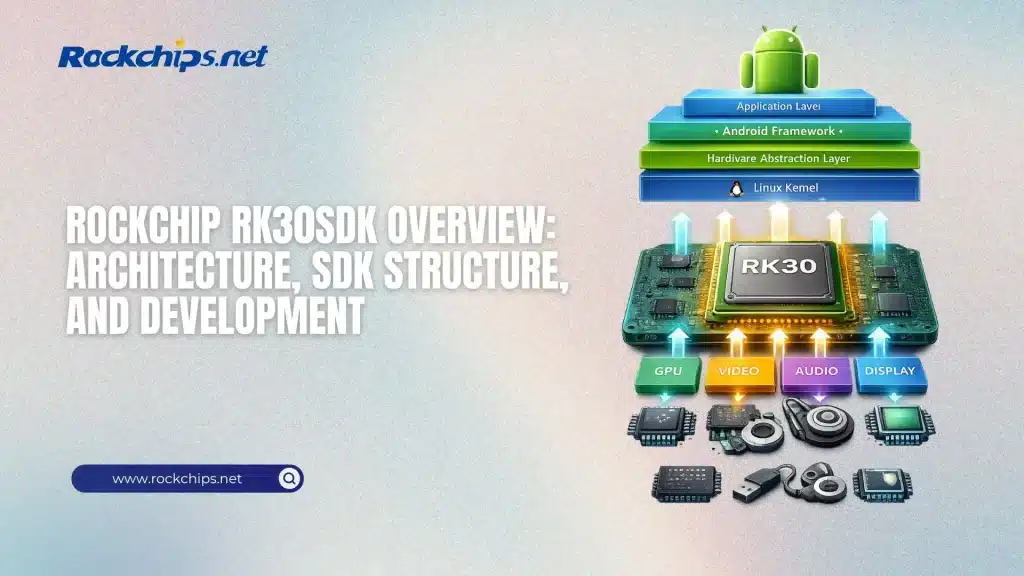
The Rockchip RK30SDK is a software development kit designed for building firmware and operating systems for the Rockchip RK30 series processors. It was widely used during the early Android tablet era and served as the foundation for many multimedia devices, including tablets, HDMI mini PCs, and embedded display systems.
The SDK provides developers with a complete Board Support Package (BSP), including the Android framework, Linux kernel sources, hardware drivers, and firmware tools required to develop and customize embedded systems. Through the Rockchip RK30SDK, manufacturers were able to rapidly build commercial products by adapting Rockchip’s reference design to their own hardware platforms.
Although the RK30 platform is now considered legacy hardware, it remains important for understanding how SoC vendors structure embedded development platforms and firmware stacks.
Table of contents
Overview of the Rockchip RK30 Platform
Rockchip is a fabless semiconductor company that develops ARM-based system-on-chip processors for consumer electronics and embedded devices. Over the past decade, Rockchip chips have powered a wide range of products, including tablets, TV boxes, single-board computers, and industrial devices.
The RK30 series, introduced around 2012, targeted Android multimedia devices and featured ARM Cortex-A9 CPU cores with Mali graphics processors. Also, you can read the last article about RK3688.
Typical hardware characteristics of RK30 processors include:
One of the most well-known processors in this family is the Rockchip RK3066, which became popular in tablets and HDMI TV sticks for its strong multimedia performance and low cost.
What Is Rockchip RK30SDK?
The Rockchip RK30SDK is the official development environment for building firmware and operating systems for RK30-series processors. In many Android builds, the device identifier rk30sdk refers to Rockchip’s reference development board.
Instead of being a single tool, the SDK is a complete software platform that includes all the components needed to develop a device.
The SDK provides several major development layers.
Android Platform Source
The RK30SDK includes a customized Android source tree designed to work with Rockchip hardware. This layer contains the Android framework, system services, application environment, and device configuration files used to compile firmware images for RK30 devices.
Linux Kernel Source
A modified Linux kernel is included in the SDK. This kernel contains board-specific configuration and patches required to support RK30 processors and their peripherals. The kernel manages hardware resources such as memory controllers, I/O interfaces, and power management features.
Bootloader Environment
The SDK also includes bootloader software that initializes hardware before the operating system starts. The bootloader prepares memory, configures clocks, and loads the Linux kernel. In many RK30 implementations, the bootloader is derived from U-Boot, which is widely used in embedded Linux platforms.
Hardware Drivers
To access the SoC’s hardware features, the SDK includes a collection of device drivers. These drivers enable the operating system to communicate with components such as the GPU, display controllers, storage interfaces, and multimedia engines.
Hardware Abstraction Layer (HAL)
The Hardware Abstraction Layer provides an interface between Android system services and low-level hardware drivers. This layer ensures that Android applications can access hardware features through standardized APIs.
Firmware Packaging and Flashing Tools
The RK30SDK includes utilities for building firmware images and flashing them onto devices. These tools package system components into a single firmware file that can be installed through USB flashing utilities.
Architecture of the RK30SDK Software Stack
The RK30SDK follows a layered architecture similar to most embedded Android platforms.
Boot Layer
The lowest layer of the system handles device startup. During the boot process, the system performs the following tasks:
- Initializes memory controllers and hardware clocks
- Loads the bootloader from internal storage
- Starts the Linux kernel
- Passes hardware configuration parameters to the operating system
Rockchip SoCs typically include a mask ROM boot stage that executes immediately upon power-on.
Kernel Layer
Once the bootloader loads the kernel, the Linux operating system takes control of the hardware. The kernel manages CPU scheduling, memory allocation, and device drivers. The RK30 kernel contains platform-specific modules for components such as:
- display subsystems
- audio controllers
- camera interfaces
- storage controllers
- networking interfaces
These drivers allow the operating system to communicate with hardware peripherals.
Hardware Driver Layer
Above the kernel core are specialized drivers that expose hardware functionality to the system. These include multimedia drivers and GPU interfaces required by Android. Examples include:
- Mali GPU drivers for OpenGL ES graphics
- Video decoding drivers for hardware media acceleration
- HDMI display controllers
- camera sensor drivers
These drivers enable hardware acceleration for graphics and video playback.
Android Framework Layer
The Android framework sits above the kernel and hardware drivers. It provides system services and APIs that applications use. Key framework components include:
- Activity Manager
- Window Manager
- Media Framework
- Graphics subsystem
Through the Hardware Abstraction Layer, these components communicate with the lower-level drivers.
Application Layer
At the top of the stack are Android applications and user interfaces. Applications interact with hardware indirectly through Android APIs. This architecture allows developers to build applications without needing direct access to low-level hardware code.
Development Workflow Using Rockchip RK30SDK
Developing firmware with the RK30SDK involves several stages.
SDK Setup
The first step is obtaining the complete SDK package. This package usually includes Android source code, kernel sources, drivers, build scripts, and firmware packaging tools. Developers typically build the system on a Linux workstation using standard Android build tools.
Board Configuration
Hardware manufacturers must adapt the SDK to match their specific device design. This process involves modifying board configuration files that define:
- GPIO mappings
- display panels
- memory configuration
- storage interfaces
- peripheral devices
These settings ensure the firmware correctly supports the device hardware.
Firmware Compilation
Once the configuration is complete, the developer compiles the firmware. The build system generates several images, including:
These components are packaged together into a final firmware file.
Device Flashing
After building the firmware, developers flash it onto the device using Rockchip utilities such as Rockchip Batch Tool or USB flashing tools. These utilities communicate with the SoC’s bootloader to install firmware images onto internal storage.
Testing and Debugging
The final stage involves testing the device to verify hardware functionality and system stability. Developers often use debugging tools such as:
- Android Debug Bridge (ADB)
- serial console logging
- kernel debugging tools
Through testing, developers optimize performance and resolve hardware compatibility issues.
Comparison With Modern Rockchip SDK Platforms
While the RK30SDK was widely used in early Android devices, modern Rockchip SDKs support significantly more advanced hardware capabilities.
This comparison illustrates how Rockchip’s SDK ecosystem has evolved to support modern computing workloads.
Typical Devices Using RK30SDK
Devices built using the RK30SDK software platform included:
- Android tablets
- HDMI TV sticks
- mini PCs
- multimedia players
- digital signage devices
These systems were primarily designed for media playback, web browsing, and lightweight applications.
Conclusion
The Rockchip RK30SDK played a crucial role in the development of early Android multimedia devices. By providing a complete firmware development environment—including Android sources, kernel drivers, bootloader software, and flashing tools—the SDK enabled manufacturers to rapidly build commercial products around RK30 processors.
Although the RK30 platform is now considered legacy hardware, the development architecture introduced by the RK30SDK established many design patterns still used in modern SoC platforms. These include layered software stacks, board support packages, and integrated firmware development workflows.
Understanding the structure and capabilities of the Rockchip RK30SDK helps developers better understand the evolution of embedded Android systems and modern Rockchip development environments.
FAQ
What is Rockchip RK30SDK?
The Rockchip RK30SDK is a software development kit for building
firmware and operating systems for RK30-series processors, such as the
RK3066, according to product documentation.
What operating systems are supported by RK30SDK?
The SDK primarily supports Android-based firmware and embedded Linux systems.
What types of devices used with RK30SDK?
Devices such as Android tablets, HDMI TV sticks, multimedia players, and
embedded display systems commonly use the RK30SDK platform.
Is RK30SDK still relevant today?
While the platform is considered legacy, it remains relevant for
maintaining older devices and for studying early embedded Android
architectures.
What replaced RK30SDK?
Modern Rockchip SDK platforms for processors such as RK3399 and RK3588
provide more advanced capabilities, including AI acceleration, modern
graphics APIs, and newer Android versions.
