


The rapid rise of intelligent robotics has moved from showcase stages into real-world industries. From flexible motion control to responsive human interaction, next-generation robots are no longer experimental – they are becoming practical tools across multiple sectors.
Behind this surge lies a critical foundation: powerful and efficient hardware platforms. Many leading robotics companies have adopted Rockchip’s RK3588 platform as the core of their solutions, thanks to its strong computing performance, system integration capabilities, and production readiness. This widespread adoption highlights Rockchip’s growing influence in the robotics ecosystem.
Table of Contents
- A Full-Stack Robotics Platform for Diverse Applications
- Optimized Performance for Core Robotics Workloads
- Integrated Modules for Faster Development
- Lower Development Complexity, Faster Time-to-Market
- RK182X AI Co-Processor: Smarter and Faster Robots
- Scaling Toward Next-Generation AI Chips
- From Concept to Mass Production
A Full-Stack Robotics Platform for Diverse Applications
Rockchip has developed a comprehensive robotics platform that spans from low-level control systems to high-level AI intelligence. This platform supports a wide range of robot types, including:
- Embodied and humanoid robots
- Industrial automation (inspection, manufacturing, logistics)
- Agricultural robotics (harvesting, spraying, monitoring)
- Service robots (delivery, cleaning, education)
- Companion and consumer robots
The goal is clear: not just to make robots move, but to enable them to see, hear, understand, and make decisions.For field deployment and on-site control of these robotic systems, operators often rely on rugged tablet PCs from specialized manufacturers that can withstand dust, drops, and extreme temperatures.
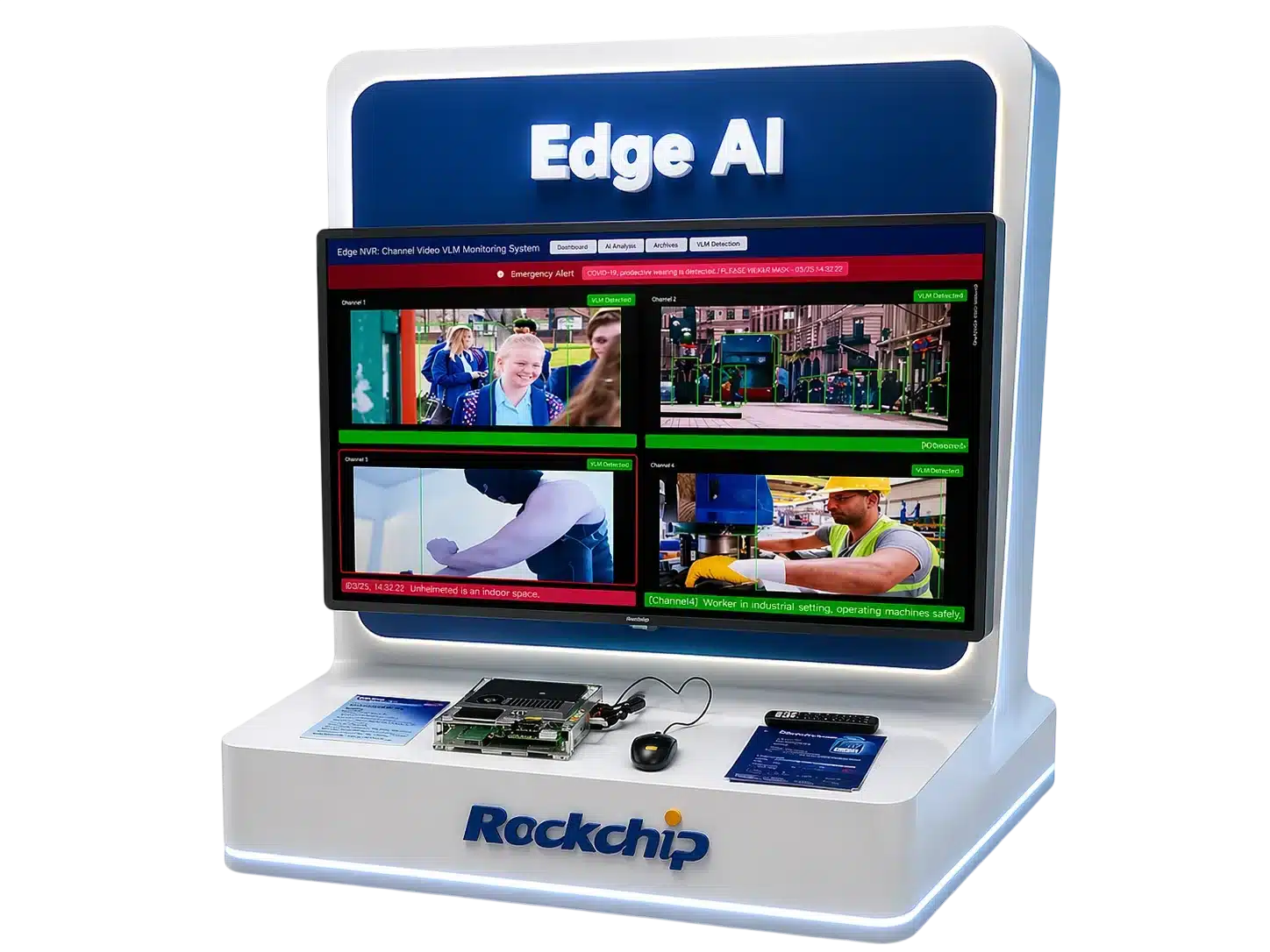
This evolution aligns closely with broader trends in edge computing, where intelligence is pushed closer to devices. In fact, modern robotics relies heavily on technologies described in real-time edge AI analytics systems, which enable instant decision-making without relying on cloud latency.
Optimized Performance for Core Robotics Workloads
To meet the demanding requirements of robotics – including real-time processing, high concurrency, and reliability – the RK platform has been deeply optimized at the system level.
It includes:
- PCL (Point Cloud Library) operators optimized for RK SoCs
- Computer vision acceleration for mapping and recognition
- High-performance data processing for SLAM and navigation
Additionally, the platform integrates:
- AMP real-time control systems
- EtherCAT master protocol
- Microsecond-level motion response
This allows precise coordination across multiple joints and actuators, which is essential for industrial and humanoid robotics.
Integrated Modules for Faster Development
One of the biggest barriers in robotics development is system integration. Rockchip addresses this with a fully integrated solution that eliminates the need to assemble fragmented modules.
Key capabilities include:
Vision Systems
Production-ready visual perception with:
- Stereo depth sensing
- Distortion correction
- Image stabilization
- Fully optimized visual SLAM
Audio Interaction
Advanced audio stack with:
- Multi-microphone arrays
- AI noise reduction
- Sound source localization
- Custom wake words and commands
ModelZoo AI Library
A comprehensive model library covering:
- Object detection
- Segmentation
- Recognition
- Decision-making
This significantly lowers the barrier for deploying AI models on edge devices.
Lower Development Complexity, Faster Time-to-Market
The RK robotics platform is built on a customized Debian + ROS2 framework, enabling developers to quickly assemble:
- Motion control
- Visual perception
- AI inference
- Application logic
With standardized interfaces, example projects, and debugging tools, developers can move from prototype to production much faster.
The platform also leverages ROS2 DDS zero-copy optimization to improve data transfer efficiency – a critical factor in real-time robotics systems.
RK182X AI Co-Processor: Smarter and Faster Robots
True intelligence in robotics goes beyond movement – it requires fast understanding and decision-making.
Rockchip introduces a hybrid architecture combining:
- RK3588 SoC for system control and sensor integration
- RK182X AI co-processor for large model inference
This separation ensures that motion control and AI processing do not interfere with each other.
This same design philosophy applies to smart security cameras, where picking the right AI chip for real‑time vision determines whether your system detects a person instantly or lags five seconds behind.
The RK182X enables:
- Efficient execution of large language models (LLMs)
- Performance exceeding 100+ TPS with models like Qwen 3B
- Near real-time (≈1 second) response for interaction and planning
This architecture reflects a broader shift toward on-device AI processing with dedicated accelerators, which reduces latency and improves privacy.
Additionally, RK182X offers excellent power efficiency, making it ideal for compact robotic systems with limited thermal capacity.
Scaling Toward Next-Generation AI Chips
As robotics continues to evolve, newer chip architectures are emerging to support more advanced AI workloads. Future platforms are expected to further expand capabilities in AI reasoning, multimodal perception, and autonomous decision-making.
For a deeper look into upcoming Rockchip architectures, see next-generation Rockchip chips like RK3688 vs RK3668, which highlight the direction of future AI hardware.
From Concept to Mass Production
From high-profile demonstrations to large-scale industrial deployment, robotics is rapidly transitioning from concept to reality.
Rockchip continues to enhance its ecosystem across:
- Chips
- Algorithms
- Modules
- Developer tools
With its full-stack platform approach, the company is enabling robotics companies to build competitive, production-ready solutions faster than ever.
The next wave of intelligent robots is no longer a vision – it is already being deployed across industries worldwide.
Original news (Chinese):https://www.rock-chips.com/a/cn/news/rockchip/2026/0324/2165.html
