


Rockchip RK3588 combines four Cortex-A76 cores, four Cortex-A55 cores and a 6 TOPS NPU. NVIDIA’s Jetson Orin Nano Super Developer Kit has six Cortex-A78AE cores, an Ampere GPU and 8GB of LPDDR5 memory, with advertised AI performance of up to 67 INT8 TOPS.
The Rockchip RK3588 processor is a chip, while the NVIDIA product includes a module and carrier board. For a purchasing decision, compare a complete RK3588 board with the Jetson kit, including storage, power supply and cooling. A bare-chip quotation won’t tell you what either finished computer costs.
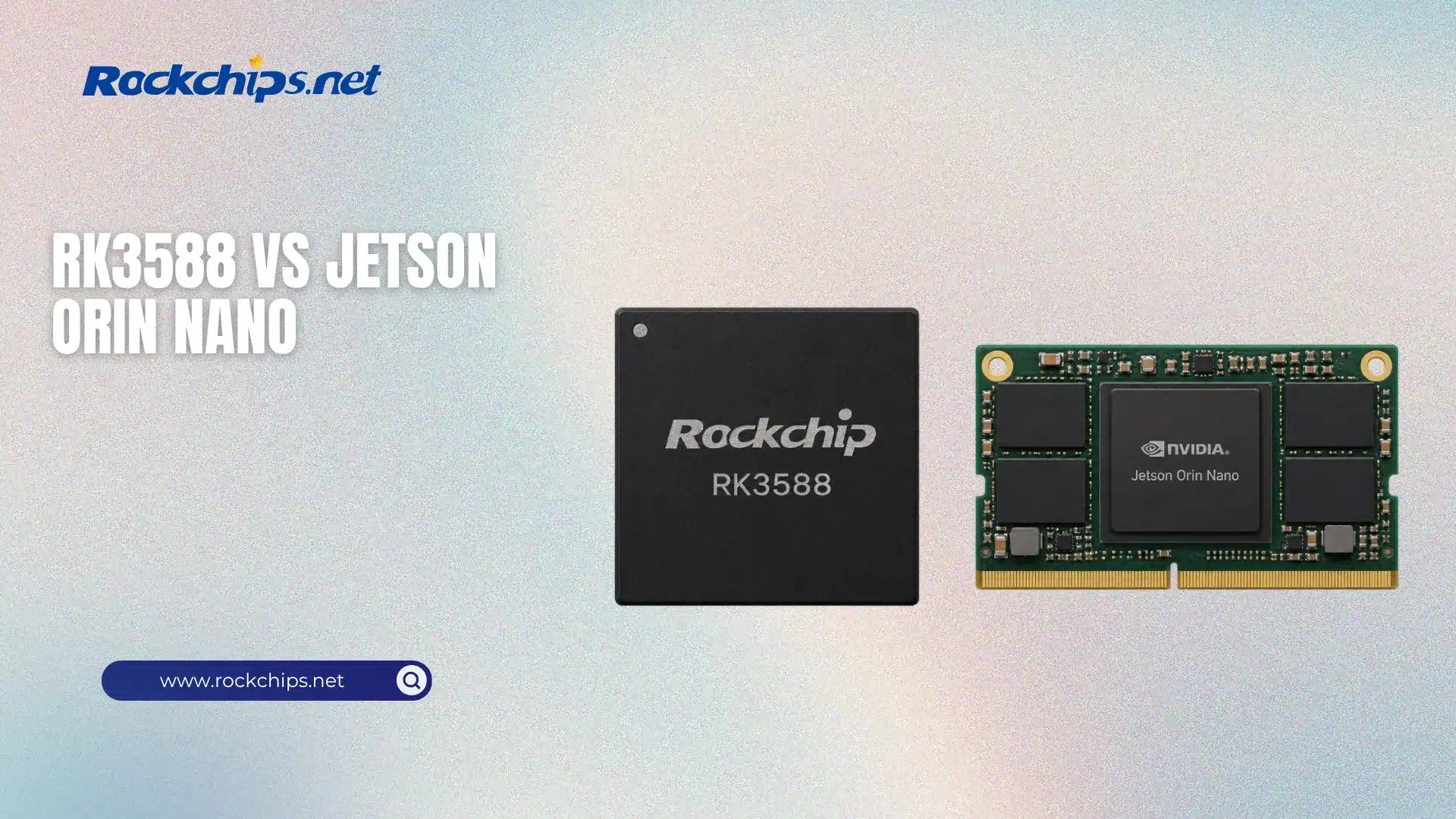
Table of Contents
RKNN or CUDA?
The TOPS figures look like an easy shortcut. But NVIDIA describes the Super kit’s 67 TOPS as sparse throughput, and dividing that by Rockchip’s 6 TOPS doesn’t produce an application benchmark. Model structure, precision, supported operators and memory transfers all affect the result. There are no matched hardware benchmarks in this comparison.
RKNN Toolkit2 handles supported model conversion for the RK3588 NPU. A typical deployment starts with an exported model, converts it for the target, then uses RKNN Runtime or Toolkit Lite2 on the board. Our ONNX to RKNN workflow covers that route for RK3588.
The conversion is part of the work. Check the model’s operators, input dimensions and preprocessing before committing to a board, and check accuracy again after quantization. Getting a file to export from a training framework doesn’t establish that its whole graph will run efficiently on the NPU.
Jetson gives you NVIDIA’s CUDA and TensorRT ecosystem. For an application that already depends on CUDA libraries, that can remove a substantial porting job; the RK3588’s Mali GPU doesn’t run CUDA software. TensorRT still has its own operator and precision requirements, so bring the actual model rather than assuming every repository will work unchanged.
For local language models, Jetson’s shared 8GB memory also needs to hold the operating system, runtime and working buffers. Weights aren’t the entire memory budget, and a longer context uses more of it. NVIDIA’s published LLM demonstrations are useful starting points, but they aren’t measurements against RK3588.
CPU and Memory
RK3588 has eight CPU cores, though four are smaller Cortex-A55 cores. Jetson’s six Cortex-A78AE cores make a different arrangement, so core count alone won’t settle a compile job or a CPU-heavy vision pipeline. On RK3588, the board manufacturer also chooses the RAM capacity and memory type; check the specific product rather than treating every board as identical.
If the application doesn’t depend on NVIDIA software, our RK3576 and RK3588 comparison gives another Rockchip option to evaluate.
| Component | RK3588 platform | Jetson Orin Nano Super kit |
|---|---|---|
| CPU | 4 × Cortex-A76 + 4 × Cortex-A55 | 6 × Cortex-A78AE |
| GPU | Mali-G610 MC4 | Ampere; 1,024 CUDA cores, 32 Tensor cores |
| AI figure | Up to 6 TOPS NPU | Up to 67 INT8 TOPS; sparse figure |
| Memory | Board-selected LPDDR4/4X/5 configuration | 8GB 128-bit LPDDR5; up to 102 GB/s |
| AI deployment | RKNN Toolkit2 and RKNN runtime | JetPack ecosystem; CUDA and TensorRT |
| Video encoding | H.264/H.265 hardware encoder, up to 8K30 | No NVENC; software encoding |
| Power comparison | Measure the selected board and peripherals | Configurable 7–25W operating modes; not wall power |
Cameras and Cooling
RK3588’s hardware H.264/H.265 encoder supports up to 8K30. Orin Nano has no NVENC hardware encoder; NVIDIA documents software encoding instead. That’s a significant difference for a device which must analyse a camera stream and record or retransmit it at the same time, since software encoding consumes CPU resources.
Camera connectors need checking too. RK3588 supports MIPI CSI and HDMI input at the chip level, but a board may expose only some interfaces, and a matching connector doesn’t supply a sensor driver. Verify the sensor, driver, capture format and inference pipeline together before ordering a production batch.
For cost, request the same configuration on both sides: usable RAM, storage, carrier, cooling and enclosure. A prototype kit and a production module aren’t interchangeable line items. Jetson’s published power modes also aren’t socket-power measurements, and RK3588 doesn’t have one universal board power figure.
Run the intended workload long enough for temperatures to settle. Record end-to-end latency, dropped frames, accuracy and input power while capture and encoding are active, because a fast inference-only result can hide a bottleneck elsewhere in the application.
You can order RK3588 processors, boards or a production batch directly through rockchips.net. Send the required quantity, memory, interfaces and software requirements to sales@rockchips.net for a configuration and quotation.
FAQ
Does RK3588 support CUDA?
No. RK3588 uses a Mali GPU and a separate NPU. Its NPU deployment route uses RKNN; existing CUDA code needs another implementation or different hardware.
Is Jetson always faster?
There isn’t a universal result. Compare the same model, accuracy target, input size and full processing pipeline; advertised TOPS alone cannot answer that question.
Can an older Orin Nano kit become Super?
NVIDIA supports a software upgrade for existing Jetson Orin Nano Developer Kits to unlock Super performance. Follow its update instructions and power-mode requirements; don’t apply that statement to the much older Jetson Nano.
Technical sources
