


Introduction
The rise of edge AI has changed what developers expect from embedded hardware. A few years ago, it was enough for an SoC to offer modest neural-network acceleration for image classification or lightweight object detection. Today, expectations are very different. Developers want on-device inference for larger vision models, multimodal pipelines, private AI assistants, and increasingly, compact large language models running close to the data source rather than in the cloud. That shift is exactly why parts such as the Rockchip RK1820 have attracted attention.
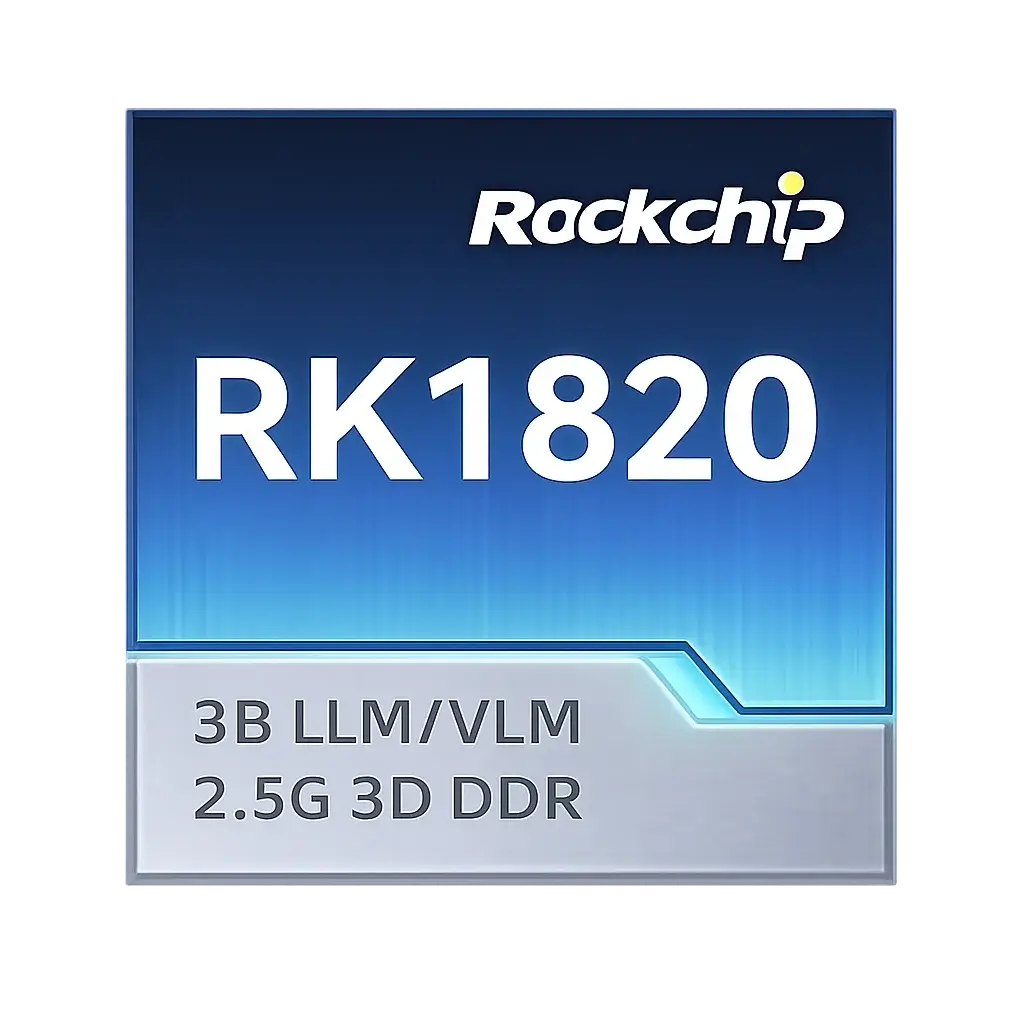
Table of Contents
- Rockchip RK1820: AI-Related Coprocessor
- What the Rockchip RK1820 Is Designed to Do
- Architecture and Platform Characteristics
- Why the RK1820 Is Different from a Typical Rockchip SoC
- Rockchip RK1820 Comparison Table
- Software Stack and Development Direction
- Practical Applications for the RK1820
- Where the RK1820 Fits in the Market
- Conclusion
- FAQ
- Sources
Rockchip RK1820: AI-Related Coprocessor
The Rockchip RK1820 is best understood not as a conventional standalone application processor, but as an AI coprocessor designed to work alongside a host platform. Rockchip describes the broader RK182X series as a high-performance coprocessor family for AI-related applications, built around a multi-core RISC-V CPU, dedicated NPU resources, local DRAM, and high-speed host connectivity through PCIe 2.0 and USB 3.0. The same product family is positioned for localized deployment of 3B and 7B-class LLMs, traditional CNN inference, and multimodal workloads.
That positioning matters because it defines the RK1820’s real role in a system. Instead of having the main SoC handle everything, designers can pair a general-purpose processor with a dedicated edge AI accelerator modules like Hailo-8 and DeepX. In practice, the host processor manages the operating system, peripheral control, scheduling, and application logic, while the RK1820 focuses on high-performance neural-network inference. Firefly’s documentation for the RK182X developer platform presents exactly this kind of division of labor, pairing a Rockchip RK3588 host with an RK1820 or RK1828 coprocessor and linking them over PCIe for low-latency, high-bandwidth exchange.
What the Rockchip RK1820 Is Designed to Do
At a high level, the Rockchip RK1820 targets a new class of embedded AI tasks that sit between conventional vision acceleration and full cloud-scale inference. Rockchip’s own product description for the RK182X family emphasizes support for both classic CNN workloads and the localized deployment of 3B and 7B models, strongly suggesting that the architecture is intended not only for standard computer vision but also for generative and multimodal inference at the edge.
That makes the RK1820 relevant in several practical scenarios. A robotics system may use the host SoC for motion control, sensor fusion, and video handling, while the coprocessor executes the AI model that interprets the scene or handles local reasoning, which is exactly how RK182X AI processors are used in robotics systems. A smart vision gateway may let the host processor handle networking, storage, and camera management while the RK1820 accelerates detection, recognition, or language-vision processing. In an industrial terminal, the host can remain responsible for the full software stack, while the RK1820 adds the extra AI headroom needed for more ambitious models without forcing a redesign around a completely different main processor. This is the logic behind heterogeneous edge computing, and it is the architectural space the RK1820 is clearly built for.
Architecture and Platform Characteristics
Rockchip’s public product page for the RK182X series describes a multi-core RISC-V CPU, integrated high-performance NPU resources, and 2.5 GB or 5 GB of DRAM, depending on configuration. It also lists support for precision formats ranging from INT4 to FP16, specifically including INT4, INT8, INT16, FP8, FP16, and BF16. On the connectivity side, the family supports USB 3.0, PCIe 2.0, and Ethernet-class connectivity through RGMII.
The most important architectural takeaway is that memory and AI acceleration are colocated. That is significant for model inference, especially when compared with a more traditional host-only design where the main processor, system memory, and accelerator resources all compete for bandwidth. With the RK1820 approach, the coprocessor is intended to shoulder a meaningful part of the model-execution burden locally, which is why Rockchip markets the family specifically for localized LLM deployment rather than only for generic NPU offload.
Why the RK1820 Is Different from a Typical Rockchip SoC
The easiest way to understand the RK1820 is to compare it with more familiar Rockchip parts. A device such as the RK3588 is a broad, high-performance application processor. It is meant to run Linux or Android, drive displays, manage I/O, process media, and accelerate AI as part of a full SoC platform. By contrast, the RK1808, an earlier Rockchip AI-oriented processor, was described by Rockchip as a low-power neural-network inference processor with a built-in NPU, but it still used a more conventional processor form factor and usage model.
The Rockchip RK1820 sits in a different category. It is not trying to replace the main processor. It extends the platform. That difference changes the system-design conversation. Instead of asking, “Is this SoC strong enough for my whole product?” the question becomes, “Do I already have a capable host, and do I now need a dedicated AI device to expand local inference capacity?” That is a much more modular way to build embedded AI systems, and it aligns with how edge workloads are evolving.
Rockchip RK1820 Comparison Table
The table below is useful not because every chip competes directly with the RK1820, but because it shows where the RK1820 sits in the Rockchip landscape.
Rockchip RK1820 Specifications
| CPU | Octa-core ARM Cortex CPU architecture |
|---|---|
| AI Performance | Integrated NPU for edge AI and local inference acceleration |
| GPU | Embedded graphics acceleration for multimedia and UI rendering |
| Video Processing | Hardware video decoding and encoding support |
| Memory Support | LPDDR memory support for high-bandwidth AI workloads |
| Storage | eMMC / NVMe / SD card support |
| Operating Systems | Android and Linux support |
| Connectivity | PCIe, USB, Ethernet, UART, SPI, I2C, GPIO |
| Display Support | HDMI and MIPI display interface support |
| Camera Support | MIPI CSI camera interface support for AI vision applications |
| Target Applications | AI cameras, robotics, edge computing, industrial AI, multimedia devices |
From an engineering perspective, the comparison highlights one essential point: the RK1820 is not best evaluated as a standalone CPU platform. Its value comes from how effectively it augments an existing edge system.
Software Stack and Development Direction
Hardware alone is not what makes an AI platform usable. Tooling matters just as much. Firefly’s RK182X documentation references RKNN3, including model zoo, runtime, toolkit, and associated components, while CNX Software reports support through the RKNN3 Toolkit and mentions model-framework compatibility, including PyTorch, ONNX, TensorFlow, and HuggingFace GGUF in Rockchip’s launch materials.
This suggests that Rockchip is positioning the RK1820 ecosystem around a more mature deployment flow than earlier NPU generations, especially for hybrid workloads that combine classic vision models with compact language or vision-language models. For developers, that matters more than marketing language. A coprocessor only becomes practical when model conversion, runtime integration, monitoring, and system management are available in a reasonably coherent toolchain. The presence of RKNN3 and platform utilities such as rknn-smi is therefore a meaningful part of the RK1820 story, not a minor footnote.
Practical Applications for the RK1820
The most convincing use cases for the Rockchip RK1820 are the ones where local inference adds real value, but a full platform change would be expensive or unnecessary.
In industrial vision, the host can manage image acquisition, storage, networking, and control logic, while the RK1820 handles the model that detects defects, interprets operator actions, or performs multimodal analysis. In robotics, the host processor may still be the best place for motion and system orchestration, but the coprocessor can add the inference capacity needed for richer perception or compact on-device assistants. In private AI terminals, the RK1820 becomes interesting because localized model deployment reduces cloud dependence and can help with privacy, latency, and predictable operating costs. These are exactly the kinds of scenarios implied by Rockchip’s emphasis on localized LLM and multimodal deployment.
Where the RK1820 Fits in the Market
The broader market trend is clear: edge devices are moving toward heterogeneous AI architectures. Rather than relying on one general-purpose chip to do everything, vendors increasingly split responsibilities across host processors, NPUs, video engines, and dedicated AI accelerators. The Rockchip RK1820 fits that movement neatly. It allows a system designer to preserve an existing host-side software and I/O architecture while increasing local AI capability in a more modular way.
That approach is attractive because it scales more gracefully. Many embedded products do not need a new main SoC every time AI requirements increase. They need a practical way to add AI throughput while keeping the rest of the system stable. This is precisely where the RK1820 makes technical sense.
Conclusion
The Rockchip RK1820 is one of the more interesting recent moves in the Rockchip ecosystem because it reflects how edge AI is actually being deployed now. Instead of treating AI acceleration as just another feature inside a general-purpose SoC, Rockchip’s RK182X family treats it as a dedicated subsystem with its own compute resources, local memory, and high-speed connection to a host platform.
For engineers, that means the RK1820 is best viewed as an AI expansion device for systems that already have a capable host processor but need more serious inference capability for vision, multimodal pipelines, or localized compact LLM workloads. Its published family-level support for 3B and 7B model deployment, mixed-precision inference, PCIe/USB connectivity, and RKNN3 tooling all point in the same direction: the Rockchip RK1820 is designed for edge products that want more local AI without abandoning an existing embedded platform strategy.
If the direction of embedded AI continues as expected, that design philosophy will likely become more common, not less. In that sense, the RK1820 is not just another chip release. It is a sign of where practical edge computing is heading.
Read more about Rockchip:
- Rockchip RK817-1 PMIC: Architecture and Linux Integration
- RK3576 vs RK3566: Engineering-First Comparison for SBCs
- Next‑Gen RK3688 vs RK3668: Rockchip’s Next-Generation Chips
FAQ
The Rockchip RK1820 is an AI coprocessor intended to work alongside a host processor rather than replace it. Rockchip positions the RK182X family for AI-related applications, including localized LLM deployment, CNN inference, and multimodal processing.
Public documentation presents the RK1820 as part of the RK182X coprocessor family, typically paired with a host such as RK3588 and connected over PCIe. That means it should be understood primarily as a coprocessor, not a self-contained general-purpose SoC platform.
Rockchip states that the RK182X family supports localized deployment of 3B and 7B LLMs, as well as traditional CNN inference and multimodal workloads.
Rockchip’s official product page lists PCIe 2.0, USB 3.0, and RGMII as connectivity options for the RK182X.
Firefly documentation references RKNN3 components such as the toolkit and runtime, while launch reporting also points to RKNN3-based support for common model frameworks.
The RK3588 is a broad-host SoC for full-system control and general embedded computing, while the RK1820 is designed to add dedicated AI inference capability to such a host platform.
Sources
- Official Datasheet RK1808: https://opensource.rock-chips.com/images/4/43/Rockchip_RK1808_Datasheet_V1.2_20190527.pdf
- Firefly RK182X documentation: wiki.t-firefly.com
- Rockchip product overview: rockchips.net RK182X series
- RK3588 product page: rockchips.net/product/rk3588
Additional references and links are embedded throughout the document.
