



Introduction
Every electrical circuit needs one thing to work: a complete path for current to flow. Break that path anywhere, and the circuit stops working. That’s what engineers call an open circuit.
It’s one of the simplest concepts in electronics, but it’s also one of the most important. Open circuits show up everywhere from a light switch that’s turned off to a broken wire inside an industrial controller. Sometimes they’re intentional. Other times they’re the reason a product suddenly stops working.
If you’ve ever traced a faulty PCB, tested continuity with a multimeter, or chased an intermittent wiring problem, you’ve dealt with an open circuit.
The concept matters just as much in modern embedded systems. Industrial controllers, robotics, IoT devices, and edge AI platforms constantly monitor connections to detect broken sensors, disconnected peripherals, or damaged cables before they cause larger failures. High-performance SoCs like the Rockchip RK3588 platform often power these systems because they combine enough compute performance with the I/O needed for continuous hardware monitoring.
In this guide, we’ll look at what an open circuit actually is, how it behaves electrically, what causes it, and how engineers find and fix these faults in real hardware.
Table of Contents
- What Is an Open Circuit?
- Common Causes of an Open Circuit
- Troubleshooting an Open Circuit
- Where Open Circuits Matter
- Open Circuit vs. Short Circuit
- Conclusion
What Is an Open Circuit?
An open circuit is exactly what the name suggests: the electrical path is open, so current can’t flow.
A voltage source may still be connected, but without a complete path between the source and the load, electrons have nowhere to go. The result is simple current drops to essentially zero.
From an electrical standpoint, an ideal open circuit has infinite resistance. According to Ohm’s Law:
I = V / R
if resistance becomes infinitely large, current becomes zero regardless of the applied voltage.
That’s what separates an open circuit from a normal operating circuit. A closed circuit provides a complete conductive loop, allowing current to flow continuously. An open circuit breaks that loop.
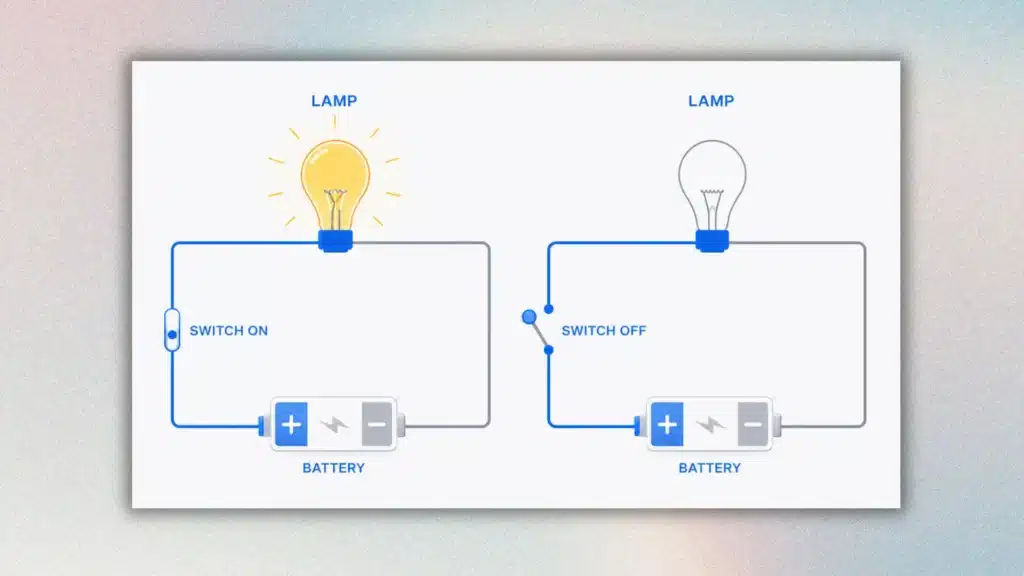
How an Open Circuit Works
Every electrical circuit shares the same basic building blocks:
- a power source;
- conductive wiring or PCB traces;
- a load;
- a complete return path.
Remove any part of that path, and the circuit immediately stops carrying current.
A household light switch is probably the easiest example. Flip the switch off, and it intentionally opens the circuit. The power source is still there, but current can no longer reach the bulb, so the light stays off.
The same idea applies to much more complex hardware. A cracked solder joint, broken PCB trace, loose connector, or damaged cable can all create an unintended open circuit. The symptoms may look different depending on the system, but the underlying problem is exactly the same: the electrical path has been interrupted.
Characteristics of an Open Circuit
Open circuits have a few characteristics that make them relatively easy to identify during troubleshooting.
- Current is essentially zero.
- Resistance becomes extremely high.
- Voltage may still appear across the break.
- The connected load receives no usable power.
- Energy is no longer transferred through the interrupted path.
These characteristics are why continuity testing is usually one of the first diagnostic steps when troubleshooting electronic hardware.
Open Circuit vs. Closed Circuit
The difference between an open and a closed circuit comes down to one question:
Can current complete the loop?
In a closed circuit, the answer is yes. Current flows from the source, through the load, and back again.
In an open circuit, the answer is no. Somewhere along the path, the connection has been broken, so current stops even though voltage may still be present.
That distinction sounds simple, but it’s the foundation of electrical troubleshooting. Whether you’re repairing a PCB, designing an embedded controller, or debugging industrial equipment, one of the first things you’ll check is whether the circuit is actually complete.
This becomes even more important in connected devices. Modern AI chips for smart cameras and other embedded platforms often include hardware diagnostics that can detect disconnected sensors, failed cables, or peripheral faults before they lead to larger system failures.
Common Causes of an Open Circuit
Open circuits don’t happen for just one reason. In some cases, they’re designed into the system. In others, they’re the result of wear, manufacturing defects, or physical damage.
Finding the root cause is usually the first step toward fixing the problem.
Broken Wires and Damaged Cables
One of the most common causes is a broken conductor.
Repeated bending, vibration, or excessive tension can eventually fracture the wire inside its insulation. From the outside, the cable may look perfectly fine, while internally the conductor has already separated.
This is especially common in robotics, industrial machinery, automotive wiring harnesses, and any equipment with moving parts.
Loose or Corroded Connectors
Not every open circuit involves a broken wire. Sometimes the connection simply isn’t making proper electrical contact.
Loose connectors, oxidized terminals, and corrosion can all interrupt the current path. Over time, moisture, dust, and vibration make these problems even worse.
A connector that works intermittently can be especially frustrating because the circuit may appear normal one moment and fail the next.
Damaged PCB Traces
Printed circuit boards are generally reliable, but they’re not indestructible.
Excessive mechanical stress, manufacturing defects, overheating, or accidental damage during repairs can crack a PCB trace. Since copper traces serve as the electrical pathways between components, even a tiny fracture can create an open circuit.
These faults aren’t always visible to the naked eye, which is why technicians often rely on continuity testing or microscopic inspection.
Failed Components
Some components fail by becoming open circuits themselves.
For example, a blown fuse intentionally opens the circuit to protect downstream electronics from excessive current. Other components including resistors, inductors, switches, and relays can also fail in an open state after years of operation or exposure to electrical stress.
When this happens, the affected component no longer carries current, even though everything around it appears to be working normally.
Poor Solder Joints
Solder joints are another common failure point.
A cold solder joint, insufficient solder, or years of thermal cycling can eventually cause microscopic cracks to form around component leads. These cracks may only disconnect the circuit under certain temperatures or mechanical loads, making the fault difficult to reproduce.
Intermittent open circuits like these are among the hardest hardware problems to diagnose.
Mechanical Damage
Physical damage is another obvious cause.
A dropped device, crushed cable, or damaged connector can easily interrupt an electrical path. In industrial environments, vibration, accidental impacts, and improper cable routing are frequent sources of open-circuit failures.
Designers often reduce this risk by adding strain reliefs, locking connectors, and flexible cable management.
Intentional Open Circuits
Not every open circuit is a fault.
Many electrical systems rely on intentionally opening the circuit as part of normal operation.
Common examples include:
- light switches;
- relays;
- circuit breakers;
- emergency stop switches;
- disconnect switches;
- safety interlocks.
These devices deliberately interrupt current flow whenever the system needs to be shut down or isolated.
Modern embedded platforms take this idea even further. Many industrial controllers and AI-powered surveillance devices continuously monitor external sensors, communication lines, and peripheral connections. If a cable becomes disconnected or a sensor fails, the system can immediately detect the resulting open circuit and trigger an alert instead of waiting for a complete system failure.
Troubleshooting an Open Circuit
Tracking down an open circuit isn’t usually about having expensive test equipment. It’s about following a logical process.
The biggest mistake is jumping straight to the component you think has failed. More often than not, the problem turns out to be somewhere else.
A systematic approach saves time and helps avoid replacing perfectly good parts.
Start at the Power Source
Before diving into the circuit, make sure the power supply is actually doing its job.
Verify that the correct voltage is present at the source. A disconnected power cable or blown fuse can easily look like an open circuit further downstream.
If the supply isn’t working, there’s little point in checking anything else.
Follow the Circuit Step by Step
Instead of guessing where the fault is, work through the circuit one section at a time.
Measure voltage at key points and check continuity where appropriate. As soon as the expected reading disappears, you’ve narrowed the problem to a much smaller area.
This approach works whether you’re troubleshooting a simple PCB or a large industrial control cabinet.
Check the Obvious First
Many open circuits are caused by surprisingly simple problems.
A loose connector, damaged cable, or partially seated plug can interrupt the electrical path just as effectively as a broken PCB trace.
Before reaching for the soldering iron, inspect every connection carefully. A quick visual check often solves the problem faster than hours of measurements.
Inspect PCBs Closely
If you’re working on a circuit board, pay close attention to the copper traces and solder joints. Understanding how the board was assembled in the first place from component placement to solder joints – makes troubleshooting much easier. Our guide to circuit card assembly covers the entire process and what can go wrong at each stage.
Hairline cracks, lifted pads, and cold solder joints aren’t always visible at first glance. Good lighting and magnification can make a huge difference, especially on densely populated boards.
If the fault appears only when the board is flexed or warmed up, you’re probably dealing with an intermittent open circuit.
Confirm the Repair
Once you’ve found the fault, don’t stop there.
Verify continuity, power the circuit back up, and make sure the original problem is actually gone. It’s also worth checking nearby connectors and components in case the failure was caused by vibration, heat, or mechanical stress that could affect other parts of the system.
A few extra minutes of testing now can prevent the same issue from coming back later.
Where Open Circuits Matter
Open circuits aren’t just something you learn about in an electronics class. They’re part of almost every electrical system you’ll come across, whether it’s a simple household appliance or an industrial automation line.
Sometimes an open circuit is exactly what you want. Other times it’s the reason a product suddenly stops working.
Here are some of the most common places you’ll encounter them.
Consumer Electronics
Many everyday devices stop working because of an open circuit somewhere inside.
A charging cable with a broken conductor, a loose USB connector, or a cracked solder joint on a laptop motherboard can all interrupt current flow. The symptoms might look like a dead battery or failed hardware, but the real problem is often nothing more than a broken electrical connection.
These faults are especially common in devices that experience frequent movement, such as headphones, charging cables, and portable electronics.
Printed Circuit Boards
On a PCB, an open circuit usually means that one part of the board can no longer communicate with another.
This might happen because of:
- a cracked copper trace;
- a lifted PCB pad;
- a failed via;
- a damaged connector;
- a broken solder joint.
Even a tiny fracture can stop an entire board from working if it interrupts a critical signal or power rail.
For hardware engineers, continuity testing is often one of the first steps when debugging a new prototype or investigating a manufacturing issue.
Industrial Automation
Factories depend on reliable electrical connections.
Sensors, PLCs, motor drives, and industrial controllers constantly exchange data and control signals. If a cable breaks or a connector comes loose, the controller may lose communication with part of the system or stop receiving sensor data altogether.
That’s why industrial equipment often includes built-in diagnostics capable of detecting open circuits before they cause unplanned downtime.
Automotive Electronics
Modern vehicles contain thousands of electrical connections.
An open circuit in a wiring harness can affect anything from headlights and power windows to engine management systems. In electric vehicles, reliable electrical connections become even more important because battery management systems continuously monitor hundreds of sensors throughout the vehicle.
Finding these faults isn’t always easy. Temperature changes, vibration, and moisture can create intermittent open circuits that appear only under certain driving conditions.
Embedded and Edge AI Systems
Embedded devices have become much more capable over the past few years, but they’ve also become more dependent on reliable hardware.
Industrial gateways, robotics controllers, AI boxes, and edge computing platforms often connect to multiple cameras, sensors, displays, storage devices, and network interfaces at the same time. A single disconnected cable or failed connector can affect the entire application.
That’s why many developers build health monitoring directly into their software. Instead of waiting for hardware to fail completely, the system continuously checks whether connected peripherals are still responding.
Electrical Safety Systems
Not every open circuit indicates a fault.
Many safety devices work by intentionally opening the electrical path.
Examples include:
- circuit breakers;
- emergency stop buttons;
- disconnect switches;
- safety relays;
- thermal protection devices.
When abnormal conditions are detected, these components interrupt current flow to protect equipment and more importantly, the people using it.
Open Circuit vs. Short Circuit
People often mix up open circuits and short circuits because both stop a device from working properly. In reality, they’re opposite electrical conditions.
An open circuit breaks the current path. A short circuit creates an unintended path with very little resistance.
The result couldn’t be more different.
With an open circuit, current has nowhere to go, so it drops to nearly zero. The device simply stops receiving power.
With a short circuit, current suddenly finds an easier path than intended. Because resistance becomes extremely low, current can rise dramatically. If nothing limits it, the result may be overheated wires, damaged components, or even fire.
Think of it this way:
- An open circuit is like a bridge that’s collapsed. Traffic can’t get through because the road ends.
- A short circuit is like an unexpected shortcut that bypasses the normal route. Too much traffic suddenly rushes through the wrong place.
That’s exactly what happens with electricity.
Key Differences
Which One Is More Dangerous?
In most situations, a short circuit is far more dangerous.
An open circuit usually causes a system to stop working. While that can interrupt production or disable equipment, it rarely damages the surrounding hardware on its own.
A short circuit is different. Excessive current can quickly overheat PCB traces, destroy semiconductors, melt wiring, or trip protective devices. That’s why fuses and circuit breakers are designed primarily to protect against short circuits and overcurrent conditions.
That said, an open circuit shouldn’t be ignored.
A disconnected sensor, broken communication cable, or failed power connection can bring an entire embedded system offline. In industrial equipment, even a single open circuit may stop an automated production line until the fault is located and repaired.
Diagnosing the Problem
One of the first questions during troubleshooting is simple:
Is current unable to flow, or is it flowing somewhere it shouldn’t?
If current has stopped completely, you’re probably dealing with an open circuit.
If protection devices keep tripping, components are overheating, or power supplies immediately shut down, a short circuit is much more likely.
Making that distinction early helps narrow the search and prevents unnecessary component replacement.
Conclusion
Open circuits are one of the first concepts every electronics student learns, but they’re also something experienced engineers deal with throughout their careers.
Whether the cause is a broken wire, a cracked PCB trace, or a loose connector, the underlying problem is always the same: the electrical path has been interrupted.
The good news is that open circuits are usually straightforward to diagnose. With a logical troubleshooting process and a few basic tools, it’s often possible to narrow the fault down quickly without replacing unnecessary parts.
Understanding how open circuits behave also makes it easier to distinguish them from other electrical faults, especially short circuits, which require a very different approach.
No matter what you’re working on a simple DIY project, an embedded system, or industrial equipment the ability to recognize and troubleshoot open circuits remains one of the most valuable skills an engineer can have.
