


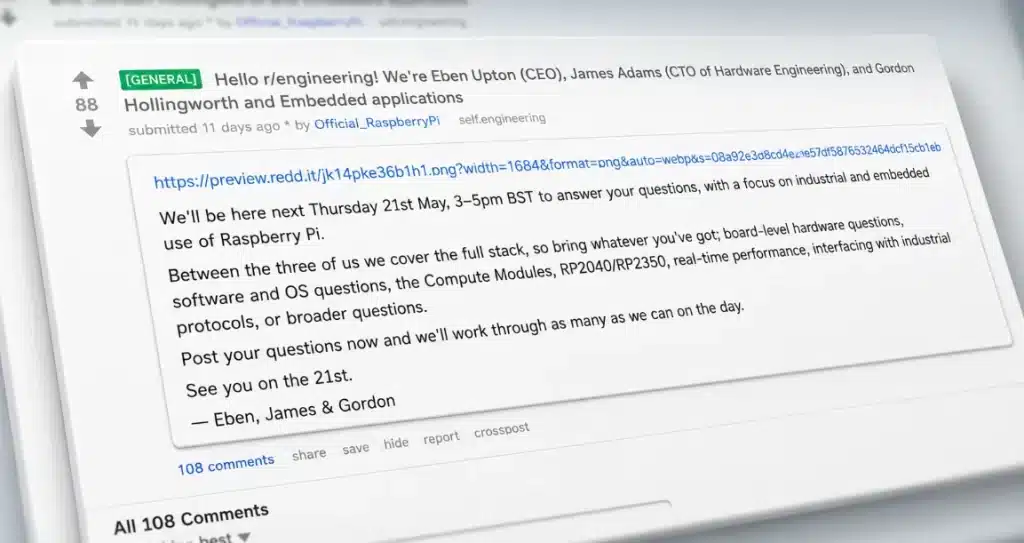
Recently, three of the lead Raspberry Pi engineers hosted an AMA on the r/engineering subreddit. And honestly? There was some good stuff. But also… some things that made me scratch my head.
Let me break it down – and throw in a few thoughts on what’s happening on the other side of the SBC world.
Table of Contents
- Raspberry Pi 6: Later Than You Think
- Pi Zero 2W and Zero 3: Supply Hell
- Microcontrollers: RP2350 Had Issues
- Software: Raspberry Pi 6 Real Moat
- The Bigger Picture: Where Did All the Cheap ARM Boards Go?
- So, What’s the Verdict?
Raspberry Pi 6: Later Than You Think
Looking at past Pi releases:
- 2012: Pi 1
- 2015: Pi 2 (+3 years)
- 2016: Pi 3 (+1 year)
- 2019: Pi 4 (+3 years)
- 2023: Pi 5 (+4 years)
Following that cycle, you’d expect Pi 6 in 2026 or 2027. But Eben (CEO) stretched the timeline to 4–4.5 years, meaning early 2028 at the earliest.
That’s a long time. Especially considering that RK3588 SBCs like Orange Pi 5 and Kiwi Pi 5 are already widely available, mature, and shipping with 6 TOPS NPU and octa-core CPUs.
Meanwhile, Rockchip is shipping chips with 6 TOPS (RK3588) and has already announced the upcoming RK3688 SBC with 32 TOPS and 12 cores.
Pi Zero 2W and Zero 3: Supply Hell
The Pi Zero 2W is still hard to get. Substrate supply is constrained – basically, so many AI chips are being made that older chips fight for the same wafers. For those who can find one or are evaluating its capabilities, our detailed guide on the Raspberry Pi Zero 2 W pinout and GPIO interfaces provides a complete breakdown of its 40-pin header and hardware peripherals.
Pi Zero 3? Not happening anytime soon. Two reasons:
- Single-sided PCB is getting harder to maintain with faster CPUs
- Newer LPDDR RAM is way too expensive for the $15 price point
The Pi Zero 2W still uses old LPDDR2 that Pi apparently has a stockpile of.
Microcontrollers: RP2350 Had Issues
James Adams said power and security were more challenging than expected with the RP2350. A new silicon revision (stepping) fixed a current leakage bug.
For mission-critical real-time tasks where cache behavior introduces jitter, Arm-based MCUs offer an alternative memory architecture: tightly coupled memory. It provides deterministic single-cycle access, bypassing cache unpredictability entirely.
Also, Picos still use micro USB. Why? Cost. USB-C connectors are more expensive and take more board space.
Fair enough. But if you’re building a product at scale, every cent matters – and that’s exactly why many OEMs choose other platforms.
Software: Pi’s Real Moat
Gordon Hollingworth – Pi’s CTO of Software Engineering – vowed to spend 95% of software engineering time on libraries, drivers, kernels, and OSes.
That’s where Pi still wins. The software experience is miles ahead of most embedded competitors.
But here’s the thing: multimedia boxes and set-top boxes powered by Rockchip have been shipping for years. The software ecosystem is mature. It’s not Raspberry Pi level polish, but for volume production? It works. And it’s cheap.This mature ecosystem extends to hobbyist projects as well; for instance, you can follow our step-by-step guide on installing RetroArch for Linux PS1 emulation to set up a powerful retro gaming system on RK3588 hardware.
The Bigger Picture: Where Did All the Cheap ARM Boards Go?
Here’s what nobody is saying out loud, raspberry Pi keeps raising prices.
Meanwhile, chips like the RK312X are still shipping in millions of units yearly – in Android TV boxes, industrial panels, POS systems. That chip was released in 2014. It’s still everywhere because it’s cheap and good enough.
Yes, it’s slow. Yes, it’s ancient. But it works. Not every project needs a flagship. Sometimes you need a $10 SoC that can decode 1080p video and run a kiosk for five years without breaking.
So, What’s the Verdict?
Raspberry Pi is still the king of software and community, but if you’re building a product for scale, or you need real AI acceleration right now, or you want an 8K media box without spending $200 – Rockchip solution is quietly eating Pi’s lunch.
The Pi 6 is 2+ years away. The RK3688 SBC? Probably ships before Pi 6. And it’ll have 32 TOPS, 12 cores, LPDDR6 – and a price that undercuts whatever Pi launches.
Just saying.
